|
The explosive demand for artificial intelligence and high-performance computing has placed unprecedented strain on data center network infrastructure. As clusters of GPUs require immense, low-latency bandwidth to operate efficiently, the physical complexity of cabling has become a critical bottleneck. A breakthrough solution is now addressing this challenge: the 400G QSFP-DD to 4x100G QSFP28 breakout cable. This technology, available in both Direct Attach Copper (DAC) and Active Optical Cable (AOC) variants, radically simplifies connectivity, enabling a dramatic 75% reduction in fiber count and delivering the flexible, high-density interconnectivity that modern AI workloads demand. 1 Decoding the Breakout Solution: Product Categories and Technical FoundationThe 400G to 4x100G breakout solution is a physical cable assembly that logically "splits" or "fans out" a single high-speed network port into multiple independent lower-speed ports. At the heart of this technology is the QSFP-DD form factor. The QSFP-DD Advantage: QSFP-DD (Quad Small Form-factor Pluggable Double Density) builds upon the widely adopted QSFP standard. Its key innovation is the addition of a second row of electrical contacts, doubling the number of high-speed lanes from four to eight. Each lane operates at 50 Gbps using PAM4 modulation, aggregating to a total of 400 Gbps. Critically, this high-density form factor maintains backward compatibility, allowing QSFP-DD ports to also accept legacy QSFP28 (100G) modules, protecting existing infrastructure investments. DAC vs. AOC: Choosing the Right Medium: Breakout solutions are delivered in two primary physical media, each optimized for different deployment scenarios:
2 Performance and Features: Engineered for Modern Data CentersBreakout cables are far more than simple adapters; they are sophisticated, high-performance interconnect solutions built with several critical features. High-Density Elastic Architecture: This solution enables a single 400G QSFP-DD port on a spine switch to provide four independent 100G downlink connections. This effectively boosts single-port bandwidth utilization by 300%, allowing network architects to maximize the value of every high-speed switch port and build more efficient, flatter network topologies. Advanced Signal Integrity: To ensure reliable data transmission at extreme speeds, these cables leverage core technologies. PAM4 (4-level Pulse Amplitude Modulation) is essential, allowing twice the data to be transmitted per signal compared to traditional NRZ coding. In AOCs, integrated Digital Signal Processors (DSP) perform critical signal conditioning, including clock recovery, reshaping, and noise cancellation, to maintain integrity over the fiber link. Operational and Economic Efficiency: The benefits extend beyond raw performance. By eliminating 75% of the physical fibers or copper lanes that would be required for four discrete 100G connections, these breakout cables drastically reduce cabling bulk, weight, and complexity. This leads to improved airflow in densely packed racks, easier troubleshooting, and significant savings in capital expenditure (CapEx) for cabling and operational expenditure (OpEx) for power and cooling. Furthermore, they support hot-swap and plug-and-play deployment, slashing installation time and complexity.
3 Transformative Applications: Powering AI Clusters and Streamlining NetworksThe primary application driving the adoption of 400G breakout solutions is the interconnection of large-scale AI/GPU compute clusters. In a typical AI training cluster, hundreds or thousands of GPU servers need to communicate with minimal latency. A top-of-rack (ToR) switch aggregating traffic from these servers requires multiple 100G uplinks to the network spine. By using a 400G-to-4x100G breakout AOC, a single spine switch port can provide four direct 100G uplinks to a ToR switch. This not only simplifies the spine switch configuration but also radically reduces the fiber trunking between switches. Where previously 16 or 32 individual fiber strands might be needed, a single, manageable breakout cable accomplishes the same task, as illustrated below. 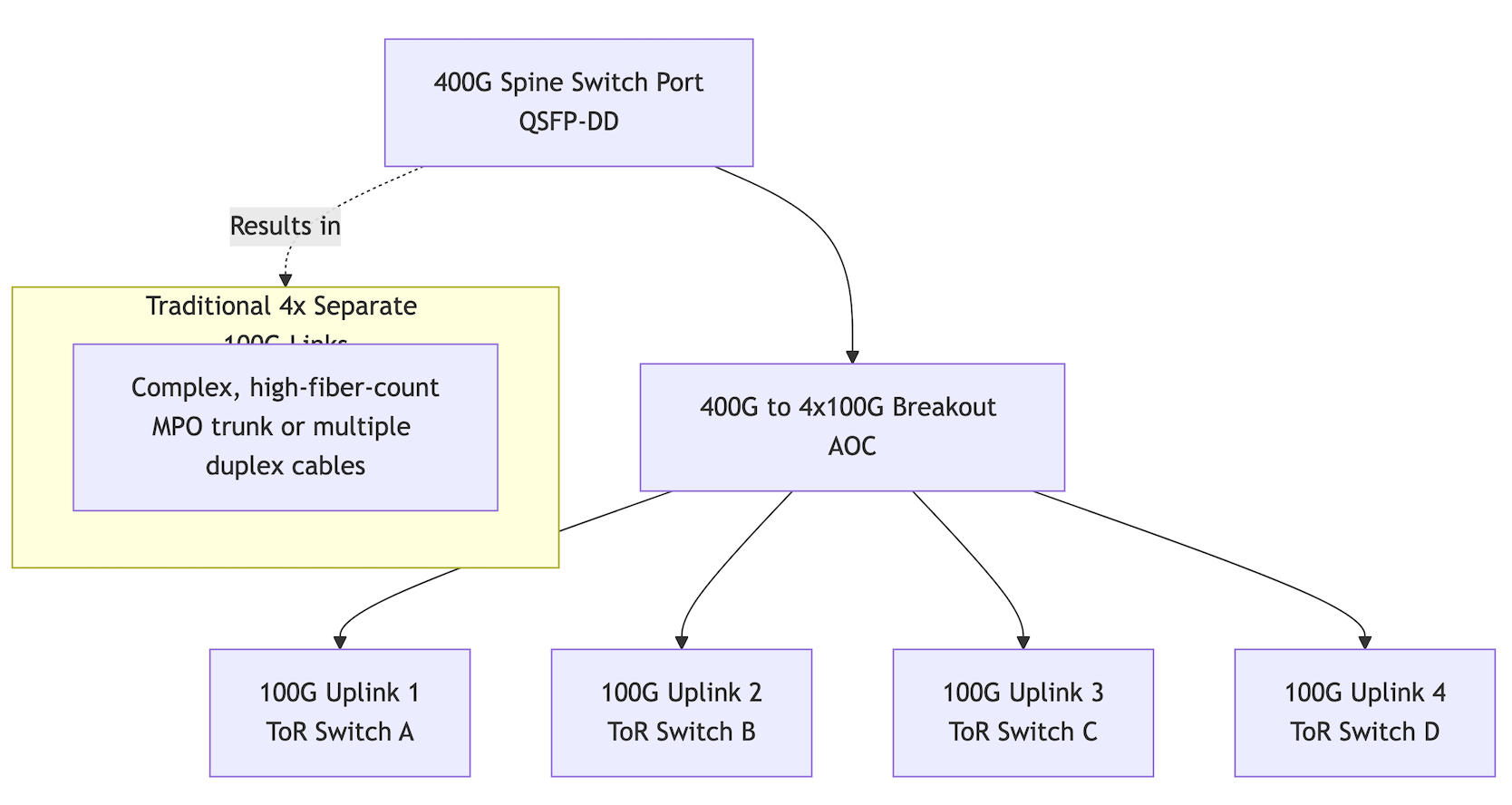
Beyond AI clusters, these breakout cables are instrumental in: Smooth Network Evolution: They provide a critical migration path, allowing new 400G core switches to connect seamlessly to legacy 100G equipment, protecting existing investments. Storage Area Networks (SAN): They facilitate high-speed connections for NVMe-oF (NVMe over Fabrics) storage arrays, ensuring data can flow at the speed of modern flash storage. High-Performance Computing (HPC): Any application requiring dense, low-latency inter-node communication benefits from the simplified, high-bandwidth topology enabled by breakout solutions.
4 Deployment Considerations and Future OutlookSuccessful deployment requires attention to a few key technical details. Network switches must have their corresponding ports configured in "breakout mode" via software to recognize and properly manage the four independent 100G channels. Additionally, ensuring Forward Error Correction (FEC) settings match between the connected devices is crucial for link stability, especially for 100G connections. Looking ahead, the role of structured, high-density cabling systems like optical shuffle solutions will grow in tandem with breakout cables. These systems pre-organize complex fiber connections in modular panels, making the management of hundreds of breakout connections in a mega-scale AI cluster systematic and scalable. ConclusionThe 400G QSFP-DD to 4x100G QSFP28 breakout solution is more than just a cable; it is a strategic network architecture tool. By directly addressing the physical layer challenges of density, complexity, and cost, it unlocks the full potential of 400G infrastructure for the most demanding AI and HPC environments. As data centers continue their relentless pursuit of higher performance and efficiency, technologies that offer such dramatic simplification—a 75% reduction in fiber count—will remain at the forefront of scalable network design.
|


