Introduction: The Resurgence of an Optimal BandIn response to the explosive growth of AI, distributed computing, and 5G, modern network operators face an increasingly complex challenge at the optical layer: how to exponentially scale data center interconnect (DCI) capacity while managing escalating costs and power consumption. At the heart of this challenge lies a critical technology choice: coherent or non-coherent Dense Wavelength Division Multiplexing (DWDM). For years, the prevailing trend favored the extreme reach and spectral efficiency of coherent technology, pushing it further into shorter-reach applications. However, a significant shift is underway, marked by the strategic return to the O-Band (1260-1360 nm) for non-coherent solutions. This renewed focus offers a compelling alternative for many DCI and metro scenarios, providing a path to simplify complexity, lower cost, and reduce latency. This article will analyze the technical and commercial drivers behind the coherent and non-coherent debate, focusing on the pivotal role of next-generation O-Band non-coherent DWDM modules. We will compare their characteristics, examine real-world applications, and provide a clear framework for selecting the optimal technology based on distance, capacity, and total cost of ownership (TCO). Part 1: Understanding the Competing Paradigms1.1 Coherent DWDM: The Benchmark for Long-Haul and CapacityCoherent transmission is the undisputed foundation of modern long-haul and ultra-long-haul optical networks. It uses sophisticated digital signal processing (DSP) to modulate the phase, amplitude, and polarization of light, enabling high-order modulation formats (like QAM) that pack vast amounts of data into a single wavelength. Core Advantage: Unmatched Reach and Spectral Efficiency. Coherent systems can achieve trans-oceanic distances and transmit terabits per second on a single fiber by tightly packing wavelengths. They inherently compensate for impairments like chromatic dispersion (CD) and polarization mode dispersion (PMD) within the DSP. Key Application: Traditional long-haul, submarine cables, and high-capacity backbone networks where distance and maximizing fiber capacity are paramount. As noted in industry reports, long-distance DWDM systems are projected to account for approximately half of the optical transport market, with DCI-related spending growing significantly. Trade-off: Complexity, Power, and Cost. This performance comes at the expense of higher module power consumption (often 5W and above for high-performance modules), significant DSP complexity, and consequently, a higher price point.
1.2 Non-Coherent DWDM: The Revival of Simplicity in the O-BandNon-coherent transmission, specifically Intensity Modulation with Direct Detection (IM/DD), is a more straightforward approach. It modulates the intensity (power) of the light and directly detects it at the receiver. Its resurgence is intrinsically linked to the unique physics of the O-Band in standard single-mode fiber. Core Advantage: The Near-Zero Dispersion Point. The O-Band coincides with the zero-dispersion wavelength of standard single-mode fiber, which minimizes signal pulse spreading. This allows for high-speed data transmission over moderate distances without the need for power-hungry and expensive dispersion compensation modules (DCMs). Key Benefit: Optimized for Cost and Power. By eliminating complex DSP and leveraging the O-Band's natural properties, non-coherent DWDM modules achieve significantly lower power consumption (e.g., <3.5W for 100G) and a simplified design, which translates to a hardware cost reduction of 30-50% compared to coherent alternatives for equivalent distances. Inherent Advantage: Lower Latency. The IM/DD signal path is inherently simpler and requires less processing than coherent detection, resulting in lower end-to-end latency—a critical metric for AI training clusters and financial trading applications.
Part 2: A Comparative Analysis for Modern NetworksThe following table summarizes the key distinctions between the two technologies in the context of DCI and metro applications: Recent innovations are expanding the boundaries of both technologies. For coherent systems, the push is toward "coherent lite" architectures that reduce complexity for DCI applications. For non-coherent O-Band, advancements like 100G PAM4 single-wavelength technology are enabling high-density, low-cost solutions for 80km DCI, and research is actively exploring its feasibility for next-generation 1.6 Tbit/s interconnects. Part 3: Strategic Selection Framework for DCI DeploymentsChoosing between coherent and non-coherent O-Band DWDM is not a question of which technology is superior, but which is optimal for a specific application. The decision hinges on three primary factors. 1. Transmission DistanceThis is the most decisive criterion. The diagram below illustrates the typical application "sweet spots" for each technology based on reach: 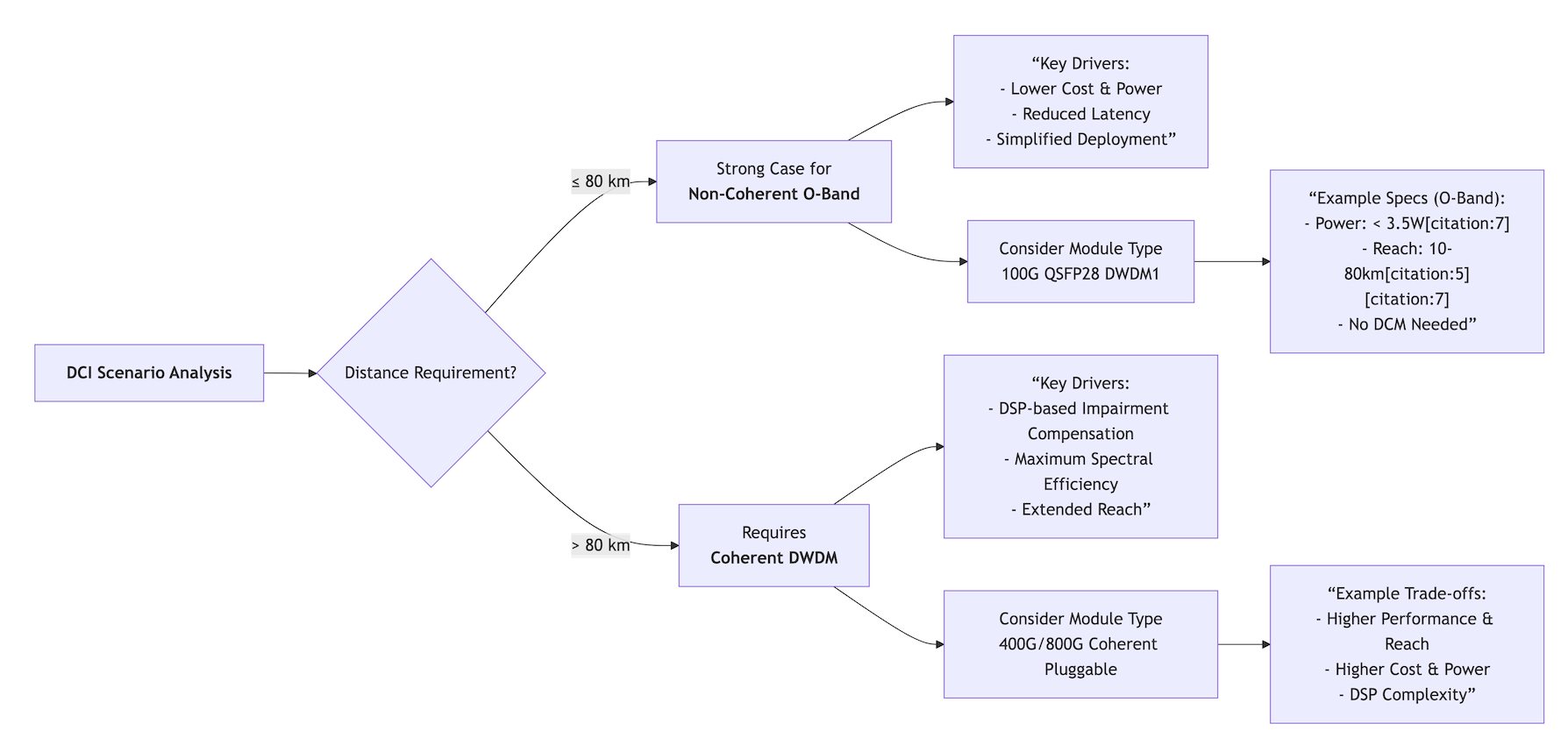
2. Capacity Requirements and Future Scalability Non-Coherent O-Band: Typically uses a 200GHz channel grid in the O-Band, supporting channels like 16 or more. It is ideal for scaling from 100G to 400G/800G per wavelength for target distances. Its strength is in delivering cost-effective, high-bandwidth pipes for specific, predictable growth. Coherent DWDM: Operates on a much denser grid (100GHz, 50GHz) in the C/L bands, supporting 40, 80, or 160+ channels. It is essential when the goal is to maximize the total fiber capacity (terabits) over long distances or when future scaling is highly uncertain and requires maximum flexibility.
3. Total Cost of Ownership (TCO) and Operational ModelTCO: Beyond module cost, consider power consumption (a major OpEx in data centers), cooling, required ancillary equipment (amplifiers, DCMs), and licensing fees for management systems. Non-coherent O-Band's advantage lies in its lower impact across all these areas for short reaches. Operational Model: The industry is moving toward open, disaggregated optical systems. Non-coherent pluggable modules (e.g., QSFP28, QSFP-DD) align perfectly with this "white box" trend, allowing network operators like AWS to gain full control over their hardware and software stack, leading to reported gains of 73% more bandwidth and 35% lower power consumption. Coherent technology is also becoming available in pluggable form factors (e.g., 400ZR), but with higher inherent cost and power.
Conclusion: Matching the Technology to the NeedThe narrative in optical networking is evolving from a one-size-fits-all coherent march to a more nuanced, application-driven strategy. For the critical and growing segment of DCI and metro edge links up to 80km, new non-coherent DWDM solutions leveraging the O-Band present a formidable, optimized alternative. These solutions deliver on the pressing demands of the AI era: radically lower cost, reduced power consumption, minimal latency, and simplified deployment. While coherent technology remains indispensable for long-haul and ultra-high-capacity scenarios, the strategic revival of the O-Band ensures that for a vast array of modern interconnection challenges, network architects have a powerful, pragmatic, and economical tool at their disposal.
|


