|
Deep in the roaring engine rooms of data centers and among clusters of high-speed computing servers, seemingly unremarkable cables are transmitting massive amounts of data at the speed of light. They are the "invisible highways" of the digital age and the "precision blood vessels" of computing power flow. When you upgrade a server with a PCIe 5.0 GPU or an All-Flash Array (AFA), have you ever wondered if the final link strangling your performance might be that overlooked connection cable? 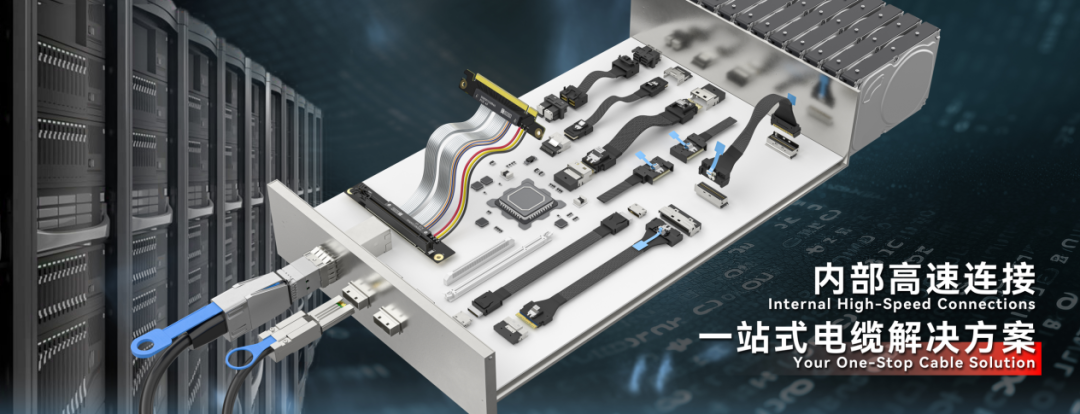
I. Technical Leap: The Bandwidth Revolution from Gbps to TbpsThe PCIe Generational Jump PCIe 3.0 (8 GT/s) → PCIe 4.0 (16 GT/s) → PCIe 5.0 (32 GT/s) → PCIe 6.0 (64 GT/s): Every iteration represents a geometric growth in bandwidth, placing rigorous demands on cable impedance stability and signal attenuation. The PAM-4 encoding technology of PCIe 6.0 specifically requires cables with ultra-low Bit Error Rate (BER) characteristics. SAS Ecosystem Evolution While SAS 3.0 (12 Gbps) remains the backbone of mid-range storage, SAS 4.0 (24 Gbps) has begun deployment in all-flash environments. Cables must now be compatible with SATA/SAS dual-mode and support long-distance backplane connections (>10 meters).
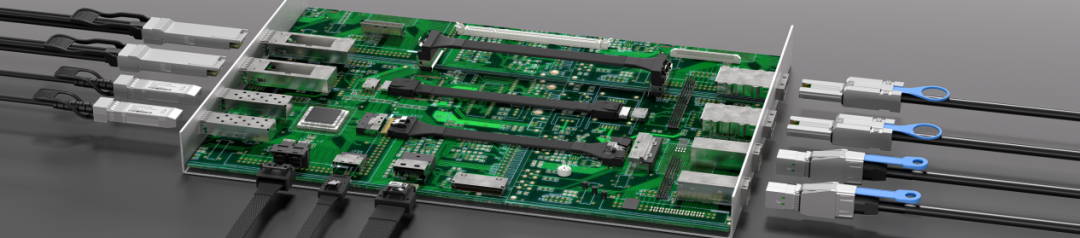
II. Interface Matrix: Precision-Matched Connection SolutionsTo meet diverse needs, different cable types offer unique advantages. Below are the five key categories analyzed alongside PCIe standards: MCIO (MiniCool Edge I/O): As the carrier for PCIe 4.0/5.0, MCIO cables are renowned for high density (30% smaller than traditional interfaces) and support 56 Gbps PAM4 signal transmission. They excel in AI servers, such as GPU cluster interconnections, reducing space usage by 20%. SlimSAS (SFF-8654): Specifically optimized for PCIe 4.0/5.0 with speeds up to 32 Gbps/lane, SlimSAS is ideal for NVMe SSD arrays. Its low-profile design (cable diameter as thin as 5mm) significantly improves chassis thermal efficiency. Mini-SAS & Mini-SAS HD: Mini-SAS supports SAS 2.0/3.0 (up to 12 Gb/s) for mid-range arrays. Its successor, Mini-SAS HD, is compatible with SAS 3.0/4.0 (24 Gb/s). Its high-density design saves space and boosts data center rack efficiency. Its greatest strength lies in strong anti-interference capabilities, making it perfect for enterprise-grade SSD and HDD connections. SATA Cables: Though a legacy type (max 6 Gbps), SATA remains valuable for backup servers or edge computing. It is recommended to use them alongside SAS cables to implement tiered storage architectures. OcuLink: (Implicitly categorized with high-density storage pools in the original text), providing microsecond-level latency for high-speed external and internal connections.
III. Key Performance ComparisonPCIe is the driving force behind cable performance. If your project involves upgrade cycles, proactive selection is vital. | Metric | PCIe 3.0 | PCIe 4.0 | PCIe 5.0 | PCIe 6.0 | | Transfer Rate | 8 GT/s | 16 GT/s | 32 GT/s | 64 GT/s | | Primary Use | Mainstream Baseline | 4K Video Processing | AI/Machine Learning | Future-proof AI/ML | | Encoding | 128b/130b | 128b/130b | 128b/130b | PAM4 | | Impact | Standard Performance | 2x Bandwidth Increase | 50% Lower Latency | Maximum Throughput |
Real-world Impact: In a data center, PCIe 5.0 cables can reduce the response time of NVMe storage arrays by 50%. A SlimSAS cable in a PCIe 5.0 environment can transfer 1TB of data in just 10 minutes. Selection Strategy: Evaluate project needs—PCIe 6.0 is for future-proofing but comes at a higher cost; PCIe 4.0 currently offers the best price-to-performance ratio.
IV. Industry Applications & Protocol Matching GuideMatch the cable to the scenario to avoid "over-design" or "performance bottlenecks": Data Center Optimization: In high-density server farms, SlimSAS or MCIO cables are recommended to reduce clutter (saving up to 15% space in a 32-bay chassis). Emerging Fields: AI training requires PCIe 5.0+ cables for GPU interconnects. Edge computing can utilize a Mini-SAS HD + SATA combo to balance performance and cost. Cloud Computing: In hyperscale environments, Mini-SAS HD and OcuLink support high-density storage pools, reducing latency to microsecond levels and improving resource utilization by 30%.
V. Finite Connections, Infinite DataWhen the world runs on data-driven tracks, the efficiency of every byte transferred reshapes business boundaries. We have specialized in high-speed interconnections for over a decade. Our products feature high-purity copper cores and are ISO certified to ensure lossless signal transmission. When you face: NVMe SSD performance falling short of targets. Abnormal communication latency in GPU clusters. Frequent speed drops in storage links. Messy rack wiring that is impossible to maintain.
A professional cable supplier is often the final, critical piece of the puzzle! 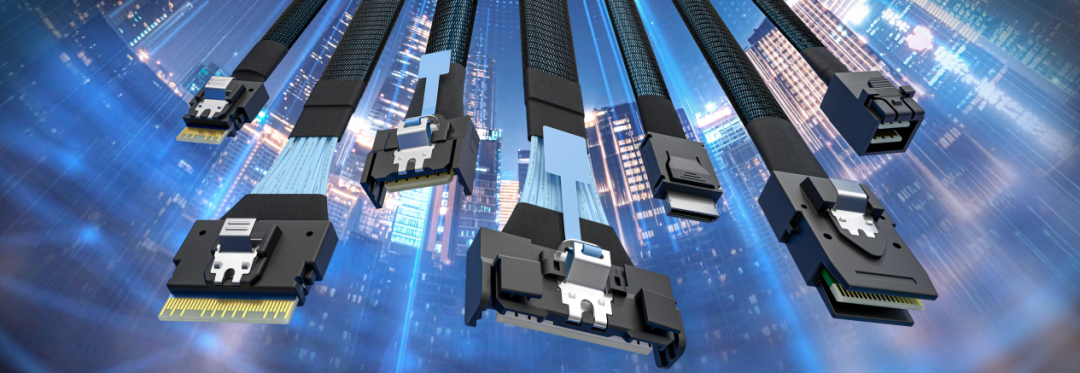
Start Your High-Speed Connection Journey Today SAS cables are the unsung heroes of the digital world. Choose the right partner so your performance is no longer limited. Whether you are an IT architect, a project lead, or a developer, we provide the professional support you need. email: sales@wiitek.com, contact us: www.wiitek.com Tel: +86-18676778807
|


